

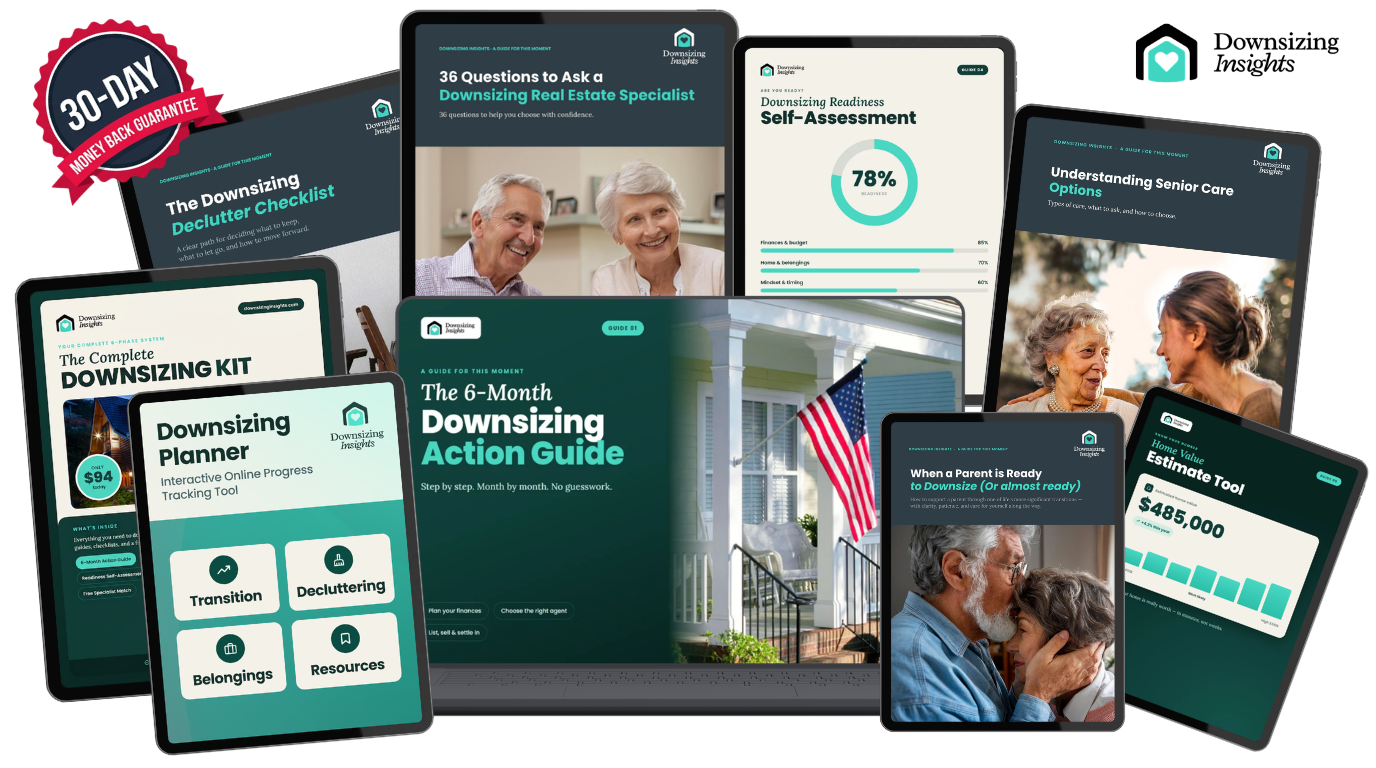
This page covers the local picture. The Complete Downsizing Kit covers the rest: six guides, one clear sequence, from finances to the final move. $94 for instant access.
Downsizing in Suffolk County usually means leaving a home that has held decades of a family's life on Long Island, whether that is a split-level in Commack, a ranch in Sayville, or a shingled cottage on the North Fork, for something smaller, simpler, and easier to manage. Suffolk County does not have one dominant city the way Manhattan anchors New York City. Instead it is ten towns, dozens of hamlets and villages, and a real range of housing stock stretching from working-class neighborhoods near the Nassau border to waterfront property in the Hamptons. What "downsizing" looks like depends enormously on which part of the county someone calls home.
This guide covers what the process tends to involve across Suffolk County: the housing people are leaving, what prompts the decision, where residents land, what it costs, how New York State and Suffolk-specific tax rules shift, and the kind of help available locally. None of it requires a timeline. Downsizing Insights put this together as an orientation, not a push toward a particular path.
What downsizing looks like in a Suffolk County home
A typical long-held Suffolk County home dates to the postwar building boom that swept across Long Island from the 1950s through the 1970s, when the county's population quadrupled in two decades. In western and central Suffolk towns like Babylon, Islip, and Huntington, that usually means a ranch or split-level on a quarter- to half-acre lot, three or four bedrooms, built for a young family that has long since grown up and moved out. Further east in Smithtown and Brookhaven, colonials and larger capes are more common. On the East End, in the towns of Southampton, East Hampton, Southold, Shelter Island, and Riverhead, the housing stock shifts again toward older farmhouses, shingled cottages, and, increasingly, homes that have appreciated well beyond their original construction cost.
These homes share some common pressure points regardless of which part of the county they sit in. Original heating and cooling systems, wells or septic systems on older properties, roofs, and windows are all aging alongside the people living in the house. A quarter-acre lot that used to take an afternoon to mow can start to feel like a standing obligation rather than a Saturday chore.
Suffolk County is the fourth most populous county in New York State, home to roughly 1.55 million residents. About 291,000 of them, or roughly 19 percent, are 65 or older, a share that has climbed steadily for decades. The median home value across the county sits around $725,000 to $750,000 as of mid-2026, though that figure hides enormous variation: a home in Mastic Beach may be worth a fraction of a comparable property in Bridgehampton.
What tends to prompt the decision here
A few factors show up repeatedly across Suffolk County, though which one leads tends to depend on where in the county someone lives.
In western and central Suffolk, retirement itself is often the trigger. Many longtime residents built their lives around a Long Island Rail Road commute into Manhattan or a job tied to Brookhaven National Lab, Stony Brook University, or the Route 110 technology corridor. Once that daily structure ends, the reasons for staying on a larger property in a specific school district often go with it.
Across the county, the physical house itself becomes the more immediate pressure. Stairs to a second-floor primary bedroom, a septic system that needs replacing, or a well pump that is decades old all tend to turn a background thought into an active one. Unlike New York City, most of Suffolk County runs on private septic and well systems rather than municipal sewer and water, and that infrastructure has a real lifespan that eventually forces a decision about whether to reinvest in the current house or move to something newer.
On the East End specifically, a different dynamic often applies. Long-held family land in Southampton, East Hampton, or on the North Fork has appreciated so significantly that downsizing becomes less about physical difficulty and more about accessing built-up equity, sometimes to help adult children, sometimes to fund a different kind of retirement entirely.
Where Suffolk County residents move when they downsize
Residents who decide to downsize tend to land in one of a few places, and the right fit depends heavily on which part of the county they are starting from.
Staying nearby, smaller
Many people look for a smaller single-level home, townhouse, or condo within the same town or an adjacent one. This keeps the same doctors, the same church or synagogue, and the same circle of friends intact. The tradeoff is that smaller, single-level inventory in popular areas like Huntington or Northport can be limited, and condos in these towns often carry meaningful monthly common charges on top of the mortgage. In more affordable areas like Mastic, Shirley, or parts of the Town of Brookhaven, the same downsizing move tends to be considerably less expensive, though it may mean a longer drive to reach the North Shore or the Hamptons.
Nassau County and the western suburbs
Some Suffolk County residents, particularly those in western towns like Babylon or Huntington, look toward Nassau County for a slightly shorter commute to New York City or a different mix of 55+ inventory. The tradeoff runs the other way too: Nassau County home prices and property taxes tend to run higher than comparable homes just across the county line in Suffolk, so the move does not always save money even when it adds convenience.
55+ and active adult communities
Suffolk County has a genuinely deep inventory of age-restricted communities, more so than most counties in the state. The Greens at Half Hollow in Melville, opened in 2003 on 400 rolling acres, is one of the most established, with an 18-hole executive golf course and roughly 810 homes across condos, townhouses, and villas. Jefferson's Ferry in South Setauket operates as a full continuing care retirement community, offering independent living with priority access to on-site health services under a life care contract. On the North Fork, Peconic Landing in Greenport is New York's only equity-based continuing care community structured as a cooperative, spread across 144 acres with patio homes, cottage homes, and apartments, and the option to add assisted living or skilled nursing coverage later. Prices and monthly fees vary substantially by community and contract type, and it is worth comparing at least two or three before deciding.
Leaving the county or the region
A meaningful share of Suffolk County downsizers leave entirely, often for the same reasons people leave anywhere in the New York metro: proximity to adult children who have settled elsewhere, a lower overall cost of living, or a desire for a milder climate. Florida and the Carolinas are common destinations. For East End homeowners in particular, the scale of built-up equity in a Hamptons or North Fork property can make an out-of-state move financially straightforward even after taxes, which is not always true for residents starting from a more modest home in western Suffolk.
What the current market means for a move like this
Suffolk County's housing market has stayed competitive through 2026, with median sale prices up roughly 5 to 8 percent year over year and homes typically selling within a month. Inventory has loosened somewhat from the tightest years of the pandemic-era market, but well-priced homes in popular school districts still draw multiple offers, particularly in the $600,000 to $700,000 range that represents the bulk of transaction volume countywide.
Conditions diverge meaningfully by geography. Western and central Suffolk, closer to the Nassau border and the LIRR corridor, tends to see steadier, more predictable demand tied to commuter access and school districts. The East End market moves on a different rhythm entirely, driven by second-home buyers, seasonal demand, and a much smaller and more specialized buyer pool, which means pricing and days on market in Southampton or East Hampton can look completely different from Islip or Babylon in the same month.
None of this points to a deadline. Market conditions are useful context for setting expectations about pricing and timeline, not a reason to move faster or slower than actually feels right. The market will still be there next season.
What downsizing actually costs in Suffolk County
Selling a home in Suffolk County involves the standard New York State closing costs, plus a few local wrinkles that surprise people who have not sold real estate here before.
The Peconic Bay tax is worth understanding even for sellers, because it is technically paid by the buyer, not the seller. It applies only in the five East End towns: East Hampton, Southampton, Southold, and Shelter Island charge 2.5 percent as of April 2023, while Riverhead remains at 2 percent. Because the buyer pays this cost on top of everything else, it factors into negotiations and pricing on East End sales even though it never appears on the seller's own closing statement.
The cost that surprises people most is not any single line item but the cumulative expense of preparing a decades-old home for sale: updating an original kitchen or bath, replacing an aging septic system before a certificate of compliance is required, or simply the accumulated cost of clearing out a house that has never been fully sorted. Pricing these out early, before listing, tends to prevent a scramble later.
Property taxes and financial considerations in Suffolk County
Suffolk County's property tax relief programs for seniors work differently than New York City's. Rather than one centralized program, the Senior Citizens Property Tax Exemption under Real Property Tax Law Section 467 is authorized by the state but administered separately by each of Suffolk County's ten towns. Each town sets its own income limit for the exemption, which can reduce a home's assessed value by up to 50 percent. This means the same income might qualify a homeowner in one town but not another, and applications must be filed with the specific town assessor, not the county, generally by March 1 each year.
Enhanced STAR, the separate school tax relief program for homeowners 65 and older, uses a statewide income threshold of $110,750 for the 2026 to 2027 benefit year, the same figure that applies across New York State. Suffolk County homeowners who qualify for the local senior exemption do not automatically receive Enhanced STAR the way NYC homeowners do with SCHE; the two programs require separate applications through the state and the town assessor respectively.
Capital gains follow the same rules statewide. The federal primary-residence exclusion shelters up to $250,000 in gains for a single filer or $500,000 for a married couple filing jointly. Gains beyond that are taxed as ordinary income under New York State's progressive brackets, which range from 4 percent to 10.9 percent. This is a particularly relevant consideration for East End sellers, where decades of appreciation can push a taxable gain well past the federal exclusion even after accounting for improvements and selling costs. A tax professional familiar with both New York State rules and the specific dynamics of East End property values is worth consulting before listing.
The part that is harder to plan for
Leaving a home that has held a family's life for decades is rarely just a logistics problem, whatever part of Suffolk County it sits in. A house in Commack that raised three kids or a family cottage on the North Fork that has hosted forty summers carries weight that does not show up on a closing statement.
Couples do not always reach readiness at the same pace, and adult children, especially those who grew up in the house or spent summers at a family beach property, often carry their own attachment to it. None of this means something has gone wrong. It means the process is real, and giving it the same attention as the financial and logistical pieces tends to make the whole transition steadier.
Sorting through decades of belongings
Sorting a Suffolk County home realistically takes several months rather than a single weekend, particularly for a house that has never been fully cleared out. Depending on volume and value, options range from a full estate sale to consignment for higher-value furniture and art to straightforward donation for everyday household items. East End households in particular sometimes carry higher-value items, art, antiques, or nautical pieces accumulated over decades, that benefit from a specialized appraisal rather than a standard estate sale valuation.
Clearing a home before it goes on the market, rather than after, tends to make the sale itself move faster. Buyers across Suffolk County respond better to homes that already feel open and uncluttered, regardless of price point.
Getting support without losing control of the process
Suffolk County has a reasonable bench of senior-focused professionals, concentrated mostly in the western and central parts of the county but generally willing to travel countywide. The National Association of Senior and Specialty Move Managers lists members serving both Nassau and Suffolk Counties, including SAMMS, based in Great Neck and covering all five boroughs plus Long Island, and other NASMM-affiliated move managers who specifically list Suffolk or western Suffolk as part of their service area. A Senior Move Manager coordinates the physical side of a move, sorting, packing, floor planning for a new smaller space, and unpacking, in ways a general moving company does not.
Real estate agents who hold the Seniors Real Estate Specialist designation from the National Association of Realtors have specific training in the financial and emotional considerations that come up when older adults sell a longtime home. Given the range of housing stock and price points across Suffolk County, from a starter ranch in West Babylon to waterfront property in Southampton, it is worth finding an agent with specific experience in the part of the county where the home sits.
Professional organizers offer a narrower kind of help focused on sorting and decision-making, useful before any listing decision has been made. Estate attorneys and tax professionals round out the picture, particularly for East End sales where capital gains exposure tends to be higher.
Common questions about downsizing in Suffolk County
Is it a good time to downsize in Suffolk County?
There is no universal answer, since the right time depends far more on personal readiness than on market conditions. Suffolk County's market has stayed competitive with prices rising steadily, but that is simply useful context alongside health, finances, and how the move actually feels, not a signal to act on a particular timeline.
How much does it cost to sell a home in Suffolk County?
Typical seller costs include a 4 to 6 percent agent commission, the 0.4 percent New York State transfer tax, attorney fees of roughly $1,500 to $3,000, and moving and prep costs that vary widely depending on the home's condition and how much sorting is involved. East End buyers additionally pay the 2 to 2.5 percent Peconic Bay Region tax, which is a buyer cost but affects negotiations on the sell side.
What property tax relief is available for seniors in Suffolk County?
The Senior Citizens Property Tax Exemption under state law Section 467 is available in Suffolk County, but each of the ten towns sets its own income limit and administers the program through its own assessor's office. Enhanced STAR, a separate statewide program, uses an income threshold of $110,750 for 2026 to 2027 and requires its own application. It's worth confirming current limits directly with the specific town assessor rather than assuming a countywide standard.
Where do most people in Suffolk County move when they downsize?
Common paths include a smaller single-level home or condo within the same or a nearby town, a 55+ or continuing care community such as The Greens at Half Hollow, Jefferson's Ferry, or Peconic Landing, or a move out of the county entirely, often to Florida or the Carolinas to be closer to family or reduce overall costs.
What happens to my capital gains if I have owned my Suffolk County home for decades?
The federal exclusion shelters up to $250,000 in gains for a single filer or $500,000 for a married couple filing jointly. Any gain beyond that is taxed as ordinary income under New York State's brackets, ranging from 4 to 10.9 percent. This is especially relevant for East End sellers given the scale of appreciation on many long-held properties, and a tax professional can model the specific numbers before a sale.
Is Suffolk County's senior tax exemption the same in every town?
No. Unlike New York City's single SCHE program, Suffolk County's Section 467 senior exemption is authorized by the state but set independently by each of the ten towns, including the income limit and the percentage reduction. A homeowner moving from one Suffolk town to another needs to reapply under the new town's specific rules rather than assuming the same eligibility carries over.
What is the Peconic Bay Region tax and does it affect sellers?
It's a real estate transfer tax of 2 to 2.5 percent charged on property purchases in the five East End towns: East Hampton, Southampton, Southold, Shelter Island, and Riverhead. The buyer pays it directly, so it does not appear on a seller's closing statement, but it factors into what buyers are willing to offer, which indirectly affects sellers throughout the East End market.
Where to start
None of this requires a decision today. If the idea of downsizing in Suffolk County is still in the early thinking stage, a reasonable first step might be an honest conversation with a partner or adult child about how the current home is actually working, without any commitment beyond that conversation.
If a current number for what the home is worth would help ground the thinking, that estimate is a practical place to begin. It does not obligate anyone to anything. Downsizing Insights also offers a free checklist built for this early stage, when the goal is understanding what the decision would actually involve rather than committing to a timeline.
Take your next step forward
You've learned the essentials. Now get the tools to move with confidence and clarity.